
Radiant Heat

Levittown houses were different from standard houses of the day in many ways. Most of these differences had to do with saving money on the cost of construction, which, in turn, saved the home buyer money at the time of purchase. Where many homes had a garage, Levittown homes had a carport. Where many homes had a basement, Levittown homes had a concrete slab. Where many homes had an attic, Levittown homes had a crawl space. Where many homes had radiator or baseboard heating, Levittown homes had radiant heat.
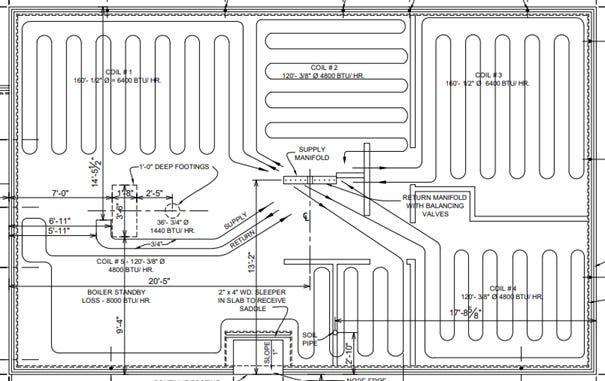
The radiant heat was ingenious. Levittown homes were built on a four-inch concrete slab foundation. Embedded into the concrete slab were copper coils that carried heated water from the oil furnace (which was in the kitchen next to the washing machine) under the tile floors of the house. The heat from the copper coils then “radiated” up through the concrete, through the floor tiles, through the carpeting, if there was any, and heated the house.
Here is a schematic of what this looked like under the house:
Heat coming up to you from the floor could be quite cozy really, and it made for some interesting lifestyle changes. For one thing, slippers were unnecessary even in the coldest weather, because the floor was warm. Board games were played with the kids splayed out on the floor. I played many a game of Monopoly, Parcheesi, Chutes and Ladders, Checkers, and Chess right on the floor in the living room or my bedroom.
The newest rage, in terms of board games was the Game of Life. Apparently this game had been around for ages, but this new version came out in 1960, and seemed to be tailor-made for the suburban family. Each player got a little plastic car, I always tried to get the blue one (my favorite color) and then traveled along a path trying to make more and more money as well as buy insurance policies and stocks.. It was the perfect Levittown warm floor, radiant heat game. It was all very mid-century American, very capitalistic, and it was endorsed by one of televisions early stars, Art Linkletter
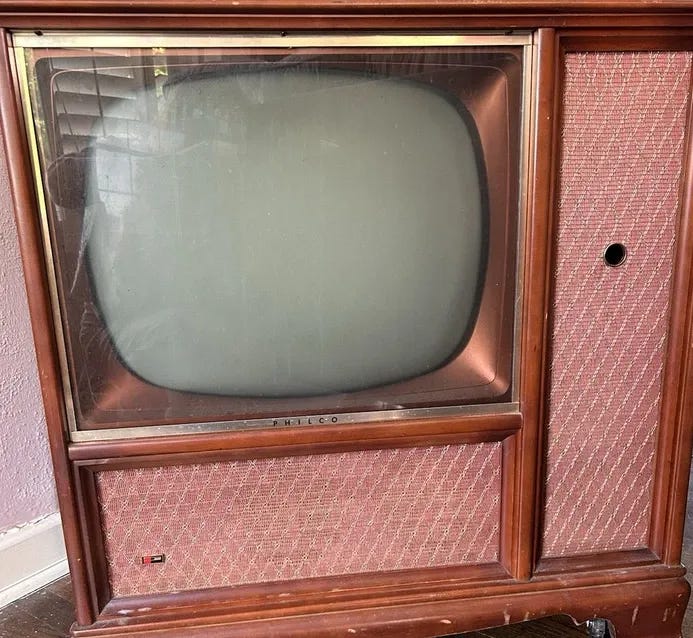
Speaking of television, radiant heat made the floor the perfect warm. comfortable spot for watching this new mandatory home appliance. In the 1950s, the television in most homes doubled as a piece of furniture. Large console cabinets provided a frame for what was actually quite a small televison screen, 12-19”. Most homes had a console that looked like the one below. It was often a Philco (Philadelphia Battery Company) because that company had a factory in nearby Croydon, PA. Almost all TVs had an antenna on top, called “rabbit ears” for reception. By moving the rabbit ears about you could get better reception. Some families had an antenna installed on the roof for even better reception, but a clear picture with no static was always a challenge and a cause of consternation for my father. In most areas, TV viewing was limited to three or four channels.
At any rate, in the evening with the heat radiating up from the floor, we kids all splayed out on the living room carpet to watch TV, while my dad sat in his chair, and my mom curled up on a sofa, occasionally joining us on the floor.
From these positions we watched The Ed Sullivan Show, The Perry Como Show, I Love Lucy, The Burns and Allen Show, The Honeymooners, and, despite my protestations, The Lawrence Welk Show. We all watched the same thing, there was only one screen in the house, and we all mostly watched what my father wanted to watch. He was a benevolent dictator, however, and we also got to see shows we really liked including Dennis the Menace, Father Knows Best, My Three Sons, The Flintstones, and The Donna Reed Show.
The radiant heat could be quirky, however. After a few years, residents began to notice “hot spots” and “cold spots” on the floor. Some areas seemed to get too much heat, some too little. Hot spots could get so hot that you could barely stand on them in your barefeet. If a hot spot happened to be in front of the bathroom mirror, you could find yourself dancing back in forth on tip-toe while you were brushing your teeth. Usually strategically placed bath mats or area rugs could be placed to avoid burns or shaving accidents. Game players and TV watchers tried to aviod uncomfortable cold spots on the living room floor during the winter months.
Despite the quirks of under the floor heating, however, the habit of watching TV from the floor died hard for me. Long after I had grown up and gone to college and gotten married and started a family, I would return home to the same living room in that same Levittown house, and although the TV screen was larger and in color now, and although the raabbit ears were replaced by a cable, I would plop myself down on the floor with my own kids and feel the reassuring warmth of the heat radiating up through that old black tile floor, look around at the warm glow radiating from the familiar faces in the room, and smile.
My Dad helped build Levittown homes and my parents bought a Rancher in Indian Creek that was my first home from 1956 to 1976. Dad also worked as an oil burner tech, for Meenan Oil and others. I worked in HVAC too (now retired). We converted many radiant floor systems to baseboard heat. When oil become considerably more expensive, baseboard typically cut the consumption of heating oil in half, at least. But I've always missed the warm floors. My wife and I raised our children in Thornridge (Jubilee) and I had to replace the radiant because it had leaks. A few points of interest regarding this radiant system: 1) in some homes, the concrete workers dragged the coils into an undesirable configuration as they pulled the wet concrete around with rakes, this contributed to a lot of the infamous hot spots. 2) the York boilers installed in Levittown used a very inexpensive temperature control called a Klixon, that was not adjustable and often ran the boilers well over 212 deg F., this made for some super hot floors (modern radiant systems are nothing like the Levittown systems). Hotter heating water meant the house could be warmed with less radiant material (saved money for Levit). The Klixon controls also allowed the boilers to get so hot that the only thing keeping the sink and shower water (domestic hot water) from boiling was the water pressure in the pipes. The moment the faucet was opened and the pressure dropped, superheated water would instantly flash into steam, spitting and sputtering, a very dangerous condition that most of us just learned to live with. 3) The cold slabs took hours to warm up, but if the boiler failed or ran out of oil, the service companies knew they had some time because it also took hours to cool down. The worst days were cold mornings with warm afternoons because the houses often overheated as the day warmed up but the slab was still hot.
Thank you. Brings back a lot of memories. I played all those games too. "Spin for kids." My dad pulled an old philco out of the trash in the early sixties, replaced a few tubes and we used it for years with the bow tie and rabbit ears antennas.